
Fort Lauderdale Used Boat Buyer Guide
Used Boat Inspection: What Fort Lauderdale Marine Surveys Can Miss in Electronics
Updated June 22, 2026 · Fort Lauderdale, FL
Field Research Note. This article is based on Boat Protection Experts field research gathered from marine survey observations, marine electronics service trends, owner feedback, pre-purchase inspection considerations, and common maintenance patterns reported around used center console and powerboat ownership. It is not intended to replace a marine survey, electronics inspection, service diagnosis, or the specific terms of any protection plan.
Why Electronics Are a Hidden Risk on Used Boats in Fort Lauderdale
Fort Lauderdale is one of the busiest boating markets in the country, with used center consoles, walkarounds, sport boats, and offshore powerboats changing hands year-round. Many of these boats look excellent at the dock. The engines may start cleanly. The screens may power on. The radar may sweep. The autopilot may engage. The sonar may display bottom readings.
But marine electronics are different from engines, hulls, upholstery, or visible hardware. Many electronic problems do not show themselves immediately. They may only appear after the boat has been running for an extended period, after the console heats up in direct sun, after the batteries are under load, or after the boat is operating at speed in choppy water.
That creates a gap for used boat buyers. A standard pre-purchase survey and four-hour sea trial may identify obvious problems, but intermittent electronic faults can be difficult to reproduce on command. Sun, heat, humidity, salt air, dockside charging cycles, heavy electronics loads, and frequent offshore use can all contribute to gradual degradation before a component fully fails.
What a Marine Survey Usually Covers
A marine survey is one of the most important steps in buying a used boat. A qualified marine surveyor can review the vessel's condition, inspect visible systems, test equipment, check safety items, document deficiencies, and help the buyer understand the boat before closing.
However, a survey is still a point-in-time inspection. It is not a long-term stress test of every electronic component. Surveyors can only report what they observe during the inspection window. If an issue does not appear while the surveyor is onboard, it may not be documented as an active failure — especially with electronics that work normally at the dock but become unstable after movement, heat buildup, vibration, voltage drop, or network communication delays.
Marine surveys are essential, but they are point-in-time inspections. Intermittent boat electronics issues may not appear during a short sea trial, especially when failures are related to heat, vibration, moisture, or voltage changes.
Electronics Issues That May Not Show During a Short Sea Trial
Based on BPE field research, the most common electronic "gremlins" on used center consoles around five years old are not always complete failures. They are often intermittent issues that surface only under the right conditions:
- Multi-function display reboots after extended use or in direct sun.
- Sonar or transducer dropouts at speed or in chop.
- Radar communication errors or scanner sync faults after warm-up.
- Autopilot inconsistencies, heading drift, or compass calibration issues.
- NMEA 2000 network faults that intermittently drop sensor data.
- GPS antenna or heading sensor inaccuracies under load.
- Voltage fluctuations from aging batteries, chargers, or shore-power components.
- Corrosion in console wiring, terminal blocks, or connectors that weren't visible at survey.
Why Center Consoles Are Especially Vulnerable
Center consoles are popular throughout Fort Lauderdale, Miami, Palm Beach, the Florida Keys, and the rest of South Florida because they are versatile, fishable, easy to run, and well-suited for coastal and offshore boating.
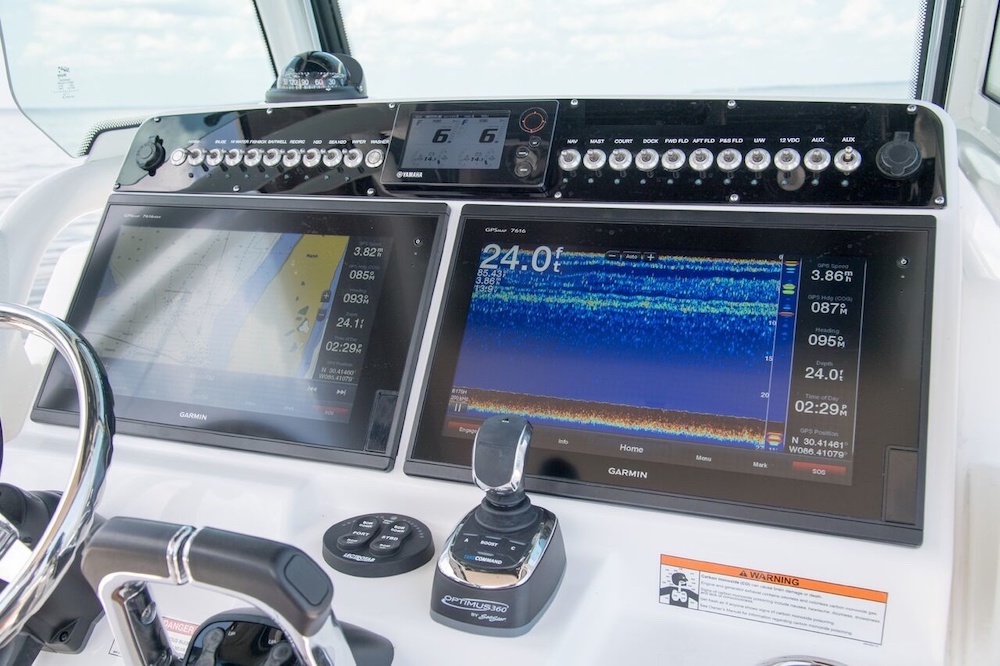
But many center consoles also carry a heavy electronics load. A modern helm may include dual or triple MFDs, radar, sonar, VHF, autopilot, joystick integration, digital switching, trim tabs, engine displays, battery monitors, cameras, stereo systems, underwater lights, and networked sensors. That creates more convenience — but also more possible failure points.
On many used boats, the electronics are exposed to years of sunlight, salt spray, moisture, console heat, battery cycling, owner-added accessories, and occasional wiring modifications. A boat may still look clean while hidden wiring connections, sensors, displays, or network components are beginning to degrade.
The Latent Defect Gap
One of the biggest challenges in used boat buying is the gap between what can be observed during inspection and what may fail later. A latent defect is a problem that exists but is not easily visible or reproducible during a standard inspection. In electronics, this may include a weak connection, failing module, moisture intrusion, software communication issue, corroded terminal, unstable voltage supply, or component that only fails after warming up.
A pre-purchase survey helps reduce risk, but it does not eliminate every unknown. That is why buyers should treat electronics as a separate review category, especially on boats with expensive helm upgrades.
Used Boat Electronics Checklist for Fort Lauderdale Buyers
Before buying a used powerboat, ask the seller, broker, or surveyor to help document the electronics history.
- Power on every MFD, radar, sonar, autopilot, VHF, and engine display — confirm they boot, communicate, and hold a stable signal.
- Run multiple electronic systems at once to surface NMEA 2000 network or voltage-supply issues.
- Inspect console wiring, terminal blocks, and behind-helm areas for corrosion, moisture, or recent unprofessional modifications.
- Check battery age, charger condition, shore-power components, and voltage under load.
- Request service records, installation invoices, and any prior electronics fault history.
- During the sea trial, operate at speed, in chop, and after the console has heated in direct sun to surface intermittent faults.
- Ask whether a separate marine electronics inspection is appropriate for the boat's helm package.
What Protection Coverage May Help With
Boat protection plans are not a replacement for a marine survey, maintenance, or proper due diligence. They also do not cover every failure, every condition, or every pre-existing issue. However, for eligible boats and qualifying components, a protection plan may help reduce out-of-pocket exposure when covered equipment fails after the plan is active. Electronics coverage can vary by plan, equipment type, age, exclusions, and whether an electronics rider or specific coverage option is included.
The most important point is simple: buyers should review coverage before closing, not after a major electronic failure occurs.
Fort Lauderdale Buyer Guidance
If you are buying a used center console, express cruiser, walkaround, or offshore powerboat in Fort Lauderdale, pay close attention to the electronics package. A boat with newer engines but aging electronics can still carry significant repair exposure. Combine a professional marine survey with a separate electronics review where appropriate, request service records and installation history, test electronics at the dock and during the sea trial, run multiple systems at the same time, and review whether the boat may qualify for protection coverage.
A clean survey is valuable, but it should not be treated as a guarantee that every electronic system will perform perfectly after purchase.
Related Fort Lauderdale Protection Guides
Final Takeaway
Marine electronics are one of the easiest areas for used boat buyers to underestimate. Screens, radar, sonar, autopilot, GPS, sensors, wiring, and networked systems may all appear normal during a short inspection but become unreliable later. For Fort Lauderdale boat buyers, the right approach is not to skip the survey — it is to combine the survey with better electronics questions, stronger documentation, realistic expectations, and a clear understanding of whether protection coverage may apply.
Reviewing a used boat? See whether it may qualify for protection plan coverage before you close.
See If Your Boat Qualifies